


गुरु का अर्थ, भूमिका और प्रेरणा । Dr. Bhupendra Sharma & Dr. Renu Paliwal
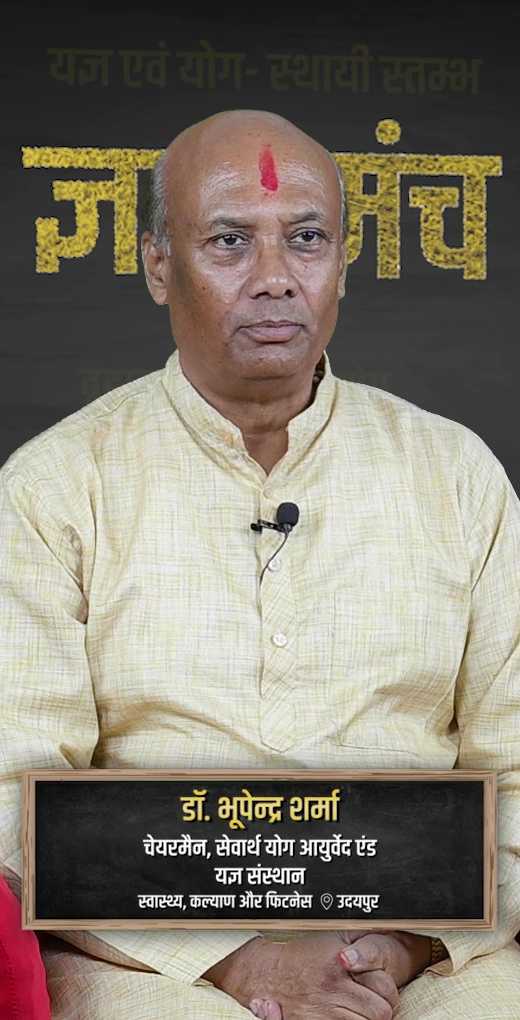
Dr. Bhupendra Sharma, Chairman of Sevarth – Yog, Ayurveda and Yagya Sansthan, Udaipur, welcomes the renowned Sanskrit Vidushi, Dr. Renu Paliwal, for a thought-provoking and spiritually rich conversation on the occasion of Guru Purnima.
The topic is deeply rooted in Indian philosophical tradition: the true meaning, significance, and reverence of a Guru. As the conversation unfolds, it becomes clear that this is more than a dialogue—it is a soulful contemplation on the spiritual scaffolding that shapes one’s entire life.
Dr. Renu Paliwal begins by extending warm greetings and heartfelt Guru Purnima wishes to everyone. She emphasizes that the word Guru is not a mere title; it holds immense depth and meaning. Etymologically derived from the Sanskrit root “Gu” (darkness) and “Ru” (the one who removes it), a Guru is one who leads us from the darkness of ignorance to the light of wisdom. Importantly, she clarifies that the ‘darkness’ referenced here isn’t that of the night, nor is the ‘light’ that of the sun. Instead, this darkness is symbolic of Agyan—ignorance, confusion, and misdirection—and the light stands for Vidya, or knowledge and clarity. A Guru, therefore, is one who transforms your inner world by guiding you out of this fog of misunderstanding into the radiance of insight and truth.
She then elaborates that the truest and highest form of a Guru is the Supreme Father—the divine source. By remembering, meditating upon, and surrendering to His qualities, one begins to rise above the chains of ignorance, injustice, and inner darkness. In this context, the Guru becomes not just a teacher but a spiritual ladder, connecting the human to the divine.
Dr. Sharma, echoing this sentiment, asks her to elaborate on the glory of the Guru. In response, Dr. Paliwal recites the timeless Sanskrit verse:
गुरुर्ब्रह्मा गुरुर्विष्णुः गुरुर्देवो महेश्वरः । गुरुः साक्षात् परब्रह्म तस्मै श्री गुरवे नमः
This shloka, she explains, is not merely poetic—it’s a lived truth that manifests in our everyday lives. The Guru is the creator (Brahma), the preserver (Vishnu), the destroyer of ignorance (Mahesh), and is ultimately the manifestation of the Supreme Brahm itself. The Guru is thus a complete force that shapes, sustains, and elevates the disciple’s being.
Even deities and incarnations revered across Indian traditions had Gurus. Lord Ram, considered an ideal being in Indian thought, had multiple Gurus. It was under the guidance of Sage Vashistha and later, Sage Vishwamitra, that he learned not just scriptures and warfare, but also the dharma of righteous living. If even Lord Ram required the presence of Gurus in his life, then how can an ordinary human even imagine progressing without one? Dr. Paliwal emphasizes that we, being mere mortals, are even more in need of this guidance, and should never underestimate the power of a mentor in shaping our lives.
Dr. Sharma shares that Lord Krishna—an embodiment of wisdom and diplomacy—was taught by Guru Sandipani. His education, values, and multi-dimensional brilliance were shaped by his teacher’s insights. These examples serve to illustrate the indispensability of the Guru in one’s life—not just for religious learning, but for holistic personal development.
Taking the thought further, Dr. Sharma adds that the very first Guru of any human is their mother. Long before a child learns to speak, before even being born, the child begins absorbing the mother’s emotional, mental, and moral imprint. The mother is the initial fountain of values, character, spiritual sense, patriotism, and devotion. She is, in essence, the first and foundational Guru.
Following the mother, the father is considered the second Guru. While he provides for the child's physical well-being through nurturing and protection, he also lays down the framework for discipline, life choices, and emotional resilience. Together, the parents form the first ‘school’ of life—परिवार पहली पाठशाला है।
As children grow, teachers in schools and colleges become their next set of Gurus. Whether they are formally recognized or not, any individual who contributes to shaping one’s thinking, ethics, or direction in life becomes a Guru. From kindergarten teachers to university professors, each plays a vital role in laying the bricks of wisdom, creativity, and responsibility.
As children grow, teachers in schools and colleges become their next set of Gurus. Whether they are formally recognized or not, any individual who contributes to shaping one’s thinking, ethics, or direction in life becomes a Guru. From kindergarten teachers to university professors, each plays a vital role in laying the bricks of wisdom, creativity, and responsibility.
“मातृ देवो भव। पितृ देवो भव। आचार्य देवो भव।”
—mother, father, and teacher are all revered at par with the divine in Indian tradition. That’s why it is essential that we not only express gratitude to our Gurus but also obey them, honor their teachings, and walk their path with sincerity.
Dr. Paliwal and Dr. Sharma, both encourage everyone to take a sacred sankalp (resolve) on the occasion of Guru Purnima: to truly respect our Gurus—not just ritually but in conduct and life choices.











Aapki Digital Pehchan


We can. Bharat can.